
This betting odds calculator works out what a bet pays in GHS: enter your stake and decimal odds to see the total return and profit, add legs for an accumulator, and read the implied probability behind each price. It is free, runs in your browser and does not need an account. Below the calculator you will find the formulas it uses, worked examples and how to apply the same maths to surebet and hedge calculations.
Odds and accumulator calculator
- Total odds
- -
- Potential return
- -
- Profit
- -
- Implied probability
- -
Odds converter
Enter decimal (3.50), fractional (5/2) or American (+250) odds.
- Decimal
- -
- Fractional
- -
- American
- -
- Implied probability
- -
Figures are before any tax, bonus or cash-out rules your bookmaker applies. The bet slip on the bookmaker site is always the final word.
How to use the betting odds calculator
- Enter your stake in cedis.
- Type the decimal odds for each selection. One line is a single; two or more lines form an accumulator.
- Read the total odds, total return, profit and implied probability.
- Change a price to see how much a small odds difference between bookmakers is worth.
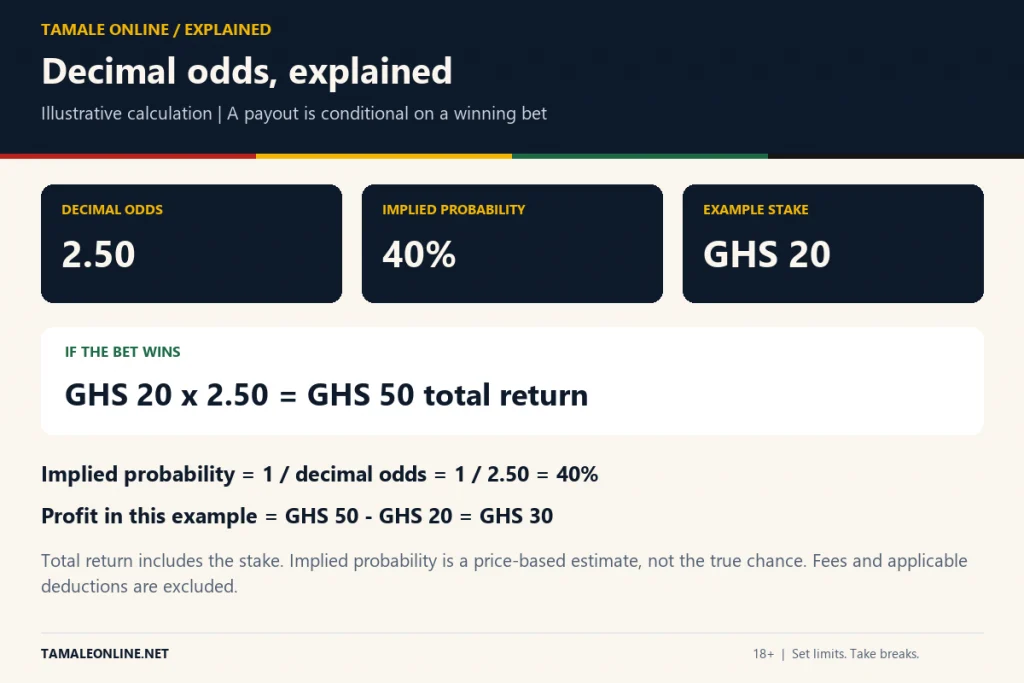
The formulas behind it
| What | Formula | Example |
|---|---|---|
| Single return | stake x odds | GHS 20 x 1.85 = GHS 37.00 |
| Profit | return - stake | 37.00 - 20.00 = GHS 17.00 |
| Accumulator odds | odds 1 x odds 2 x odds 3 ... | 1.50 x 1.70 x 2.10 = 5.355 |
| Accumulator return | stake x total odds | GHS 10 x 5.355 = GHS 53.55 |
| Implied probability | 1 / odds | 1 / 1.85 = 54.1% |
| Fair odds from a chance | 1 / probability | 40% chance = 2.50 |
The calculator shows gross figures. An operator's maximum payout cap or bonus rules can change the final amount, so read the terms of the site you use. Our betting tax guide covers deductions on winnings in Ghana.
Accumulator odds calculator: why legs add risk
Each leg multiplies the total odds, which is why long slips show eye-catching returns. It also multiplies the chance of losing. Four legs at 1.50 each give total odds of about 5.06, but if each pick truly wins two times in three, the slip lands only around one time in five. Run your own slip through the calculator and compare the implied probability of the total with how often you really expect it to come in. The accumulator tips page applies this to real fixtures.
Implied probability and the bookmaker's margin
Add the implied probabilities of every outcome in a market. The amount above 100% is the operator's margin, sometimes called the overround. A 1X2 market priced 2.40, 3.30 and 3.10 gives 41.7% + 30.3% + 32.3% = 104.2%, so the margin is about 4.2%. Lower margins mean better prices for you. Comparing margins on the same match is a quick way to see which licensed site is pricing generously; our best odds betting sites page does this across operators.
Surebet and arbitrage calculator maths
A surebet, or arbitrage, happens when the best prices at different bookmakers add up to less than 100% implied probability. To split a total stake so that every outcome returns the same amount:
- Work out 1 / odds for each outcome and add them up. Call the sum S.
- If S is below 1, an arbitrage exists on paper.
- Stake on each outcome = total stake x (1 / its odds) / S.
- Return on any outcome = total stake / S.
Two-way example with GHS 200: odds 2.10 and 2.05 give S = 0.4762 + 0.4878 = 0.9640. Stake GHS 98.80 at 2.10 and GHS 101.20 at 2.05; either result returns about GHS 207.47. The catches are covered in our betting strategy guide: prices move, rules differ, and operators can limit accounts used this way, so the profit is not risk-free in practice.
Hedge and cash-out checks
If an accumulator is down to its last leg, you can compare a cash-out offer with a hedge. A hedge means betting against your last selection elsewhere so that you secure part of the return whichever way it goes. Hedge stake = potential return of the original bet / odds of the opposite outcome. If your slip will pay GHS 300 and the opposite outcome is priced 3.00, a GHS 100 hedge returns GHS 300 if your last leg fails. Work out both scenarios with the calculator before deciding; a cash-out offer from the operator often includes a margin.
Other bet calculator types
- System bets: a system splits a slip into many smaller multiples. Each combination is calculated as an accumulator, then the results are added.
- Each way: mainly for horse racing and outrights, rarely used on Ghanaian football coupons. Half the stake goes on a win and half on a place at a fraction of the odds.
- Matched betting: uses free bets and exchanges, which are not a regular feature of the Ghana market, so we do not cover it here.
Calculators are for adults 18+ who already bet and want to understand the numbers. They show what a price means; they cannot tell you what will happen on the pitch.
Frequently asked questions
How do I calculate betting winnings?
Multiply your stake by the decimal odds to get the total return, then subtract the stake for profit. GHS 50 at 2.20 returns GHS 110, which is GHS 60 profit.
How are accumulator odds calculated?
Multiply the odds of every leg together. Three legs at 1.50, 1.70 and 2.10 give total odds of 5.355.
What is implied probability?
The chance the odds suggest, calculated as 1 divided by the decimal odds. Odds of 2.00 imply a 50% chance.
Can a surebet calculator make betting risk-free?
No. It only does the stake split. Price changes, different settlement rules and account limits can all break an arbitrage in practice.
Does the calculator include payout caps or bonuses?
No. It shows gross returns. Check the operator's terms for payout limits and bonus conditions.
 By